
Software Development Engineering
On-campus
3 años + 1 año optativo en DBS (180 ECTS)
- No prior knowledge required

Bachelor's degree in the European Qualifications Framework (EQF) by Dublin Business School

Programme endorsed by Nebrija Institute from March 2025

In collaboration with HP SCDS
Why study Software Development Engineering?
La formación de Ingeniería de Desarrollo de Software de IMMUNE es un programa de 3 años orientado a quienes quieren formarse en ingeniería de software con una visión práctica y conectada con el entorno tecnológico actual.
El programa combina bases de ingeniería informática, análisis de datos, ciberseguridad, ciencias humanas y emprendimiento para que el alumno pueda planificar, diseñar y optimizar proyectos tecnológicos.
By studying this programme, you will be awarded a degree from IMMUNE Technology Institute. In addition, by completing an academic year at Dublin Business School (DBS), recibirás un título oficial del estado irlandés NFQ Level 8, equivalente a un título de grado en el Marco Europeo de Cualificaciones (MEC).
Además, el programa contempla un año académico en Dublin Business School (DBS) para quienes quieran ampliar su itinerario formativo dentro de un contexto internacional. Este bloque debe mantenerse alineado con la formulación académica validada por cliente sobre titulación y reconocimiento.
International stay at Dublin Business School
Dublin Business School, partner de IMMUNE, forma parte del itinerario internacional del programa en Ingeniería de Software para los alumnos que quieran ampliar su recorrido académico en un entorno internacional.
Se trata de una institución educativa reconocida por el Quality & Qualifications Ireland (QQI), la agencia nacional responsable de la calidad y el reconocimiento de las cualificaciones en Irlanda.


What will you learn?
- Fundamental knowledge of software engineering: principles, methodologies and life cycles.
- Define and design innovative software-based tools.
- Efficient solution of computer problems. Analyse feasibility, computational complexity and apply algorithmic solutions.
- Information systems. Storage, processing and access.
- Critical thinking and problem solving. Development of skills such as initiative, autonomy, creativity and communication.
- Project management under agile methodologies such as SCRUM.

Preparation for Software Engineering certifications

What will you learn in Software Development Engineering?
The Software Development Engineering programme is designed to build a solid foundation in programming, software architecture and technological development, integrating technical subjects with content focused on business, communication and professional context to achieve practical, applied training.
Throughout the programme, you will learn to design, develop and maintain software systems and applications using different programming languages and methodologies.
You will also develop a project portfolio, gain practical experience and coding hours, complete professional certifications, access company placements and enhance your professional and teamwork skills.
Year 1
On-Boarding: Framing and Soft Skills
Software Development Fundamentals I
Fundamentals of software development, allowing the student to start creating basic desktop programs. We start by installing an Ubuntu distribution on our laptop and learning how to use Ubuntu at user level. Then we follow the official Python Tutorial to learn the basics of programming and finally we face the challenge of solving a practical case for which we will need to make use of what we have just learned.
- Creation of basic programmes.
- Variables.
- Control structures.
- Basic memory structures.
- Conditions.
- Functions.
- Input/Output.
- Embedded data structures.
Software Development Fundamentals II
Fundamental programming concepts. Designed to develop skills in the application of basic programming language methods to abstract problems. Topics include basic programming concepts and Python, computational concepts, software engineering, algorithmic techniques, data types and recursion. The laboratory component consists of software design, construction and implementation.
Entrepreneurship I
Introduces students to the essential methodologies and tools for articulating and presenting innovative value propositions in the context of software development. It focuses on developing key skills for effectively communicating complex ideas, with an emphasis on structuring and presenting projects through a pitch deck. This subject addresses the growing labour market demand for profiles capable of conceptualising and communicating technology projects clearly and persuasively. It also contributes to students’ all-round development by fostering critical thinking, structured argumentation and leadership skills, all of which are fundamental to their personal and professional progress in a dynamic business environment.
Data Structures
The most common data structures used by developers when creating software. We will face practical challenges that will make it easier to learn how the most common data structures (lists, trees, graphs and hash tables) work. To do this, we will first create our own implementation for these data types and then integrate our libraries into a program that we have created for a previous block.
Computer Science I
Elementary discrete mathematics for science and engineering, with special attention to mathematical tools and proof techniques useful in computer science. Topics include logic notation, sets, relations, elementary graph theory, state machines and invariants, induction and proofs by contradiction, recurrences, asymptotic notation, elementary analysis of algorithms, elementary number theory and cryptography, permutations and combinations, counting tools and discrete probability.
Algorithms
The most common algorithms commonly used to solve sorting and searching problems.
We will tackle practical challenges that will make it easier to learn the most widely used algorithms for solving list sorting and list element search problems. To do this, we will first create our own implementation of these algorithms and then integrate our libraries into a program created for a previous block.
Computer Architecture
Study of computer components and discusses the techniques used by current systems to obtain high performance by exploiting parallelism.
Object-Oriented Programming
Object-oriented programming paradigm. We will tackle a practical challenge in which we will need to use object-oriented programming to manage scientific data that fit this paradigm. It will involve not only using classes and methods, but also making effective use of the key principles of Object-Oriented Programming: encapsulation, data abstraction, polymorphism and inheritance.
Operating Systems
Design project: The main assignment is the design project (DP). This project is where students get to design their own system, which is the main objective of this course.
The DP requires you to develop a detailed system design to solve a real-world problem. This project will span most of the course, and will be done in teams of five students. Real-world systems are not built individually; it is always a team effort. Part of the PD is learning how to work productively and effectively in this environment. We will give you tools to do this in the writing tutorials.
Code Optimisation
It presents the fundamental principles and techniques of software development: how to write software that is safe from bugs, easy to understand and ready for change. Topics include specifications and invariants; testing, test case generation and coverage; abstract data types and representation independence; design patterns for object-oriented programming; concurrent programming, including message passing and shared memory concurrency, and defending against races and locking; and functional programming with immutable data and higher-order functions. Includes weekly programming exercises and larger group programming projects.
Computer Science II
Elementary discrete mathematics for science and engineering, with special attention to mathematical tools and proof techniques useful in computer science. Topics include logic notation, sets, relations, elementary graph theory, state machines and invariants, induction and proofs by contradiction, recurrences, asymptotic notation, elementary analysis of algorithms, elementary number theory and cryptography, permutations and combinations, counting tools and discrete probability.
Year 2
Web Programming I
Basics of client-side web programming. We will face the challenge of creating the client-side part of a business. To do this, we will use HTML to create the web page, CSS for layout and JavaScript for event handling. We will also take care of client-side web security.
Web Programming II
Basics of server-side web programming. We will face the challenge of completing our business by implementing its server-side part, making use of a server-side programming language, accessing a database and taking care of server-side web security. All this will be done following the Model-View-Controller design pattern.
Advanced Databases
We will face the challenge of creating a programme that is capable of managing a company's customer information. This will include performing the corresponding data modelling, defining the Entity-Relationship model, creating databases and tables, and implementing all the functionalities to access the database using SQL. Then, develop a system that makes use of a schema-less database to store, manage and display heterogeneous information from several different sources, each using its own data format. Optionally, students can opt for a distributed solution if they wish.
Mobile Programming I
Basics of Android mobile programming. We will be challenged to create an Android application using Android Studio. This will include managing Android manifests, Graddle build files, activities, snippets and graphical widgets, event handling, layout and styling.
Mobile Programming II
We will face the challenge of creating an advanced Android App that is able to act as a multimedia shop to display/play and record/capture audio, images and video. This App will access a local database to keep track of the information it handles, and will also be able to connect to external servers to exchange complementary information.
Software Engineering I
Basics of classical software engineering. Students are divided into groups and each group thinks of a project. Then, each group takes the requirements of another group and follows the usual software development life cycle to generate all the corresponding documents (requirements, design, implementation, testing, installation and maintenance). It is not necessary to write source code for the mandatory part. Optionally, students can write the corresponding source code, verify it and then validate it with the client group.
Agile Methodologies
Latest trends and methodologies related to software engineering. Students are separated into groups and each group thinks of a project (which must be different from the previous project in Software Engineering block I). Then, each group will follow the latest trends in software engineering (Lean and Agile methodologies, Kanban method and Scrum methodology) to develop that project. At the same time, students will act as potential clients of the projects they do not belong to.
Cloud Computing
Cloud computing. We faced the challenge of evaluating and testing how to work in the cloud.
Cybersecurity
Importance of cybersecurity and its basic principles and techniques.
Entrepreneurship II
This module continues the development of entrepreneurial skills, focusing on execution and strategy for creating a new business. It explores the generation and validation of startup ideas in greater depth, and practises the ability to communicate them effectively through an elevator pitch.
The course covers the fundamentals of business strategy, guiding students in the creation of a Go-to-Market model. The culmination of the module is the development of a detailed Business Plan, integrating all the elements studied to shape a viable project. This knowledge prepares students not only to start their own company, but also to work in strategic roles within innovative organisations.
- Introduction to the world of entrepreneurship
- Ideas workshop to create a startup
- Elevator Pitch
- Introduction to strategy
- Commercialisation model: Go-to-Market
- Building a Business Plan
Networking
Use of the network and its related protocols. We will face the challenge of creating a client-server solution that allows the users of the client program to share information that will be stored in a program-server that can be accessed by all. This challenge will facilitate learning the client-server paradigm and the basic procedures commonly used to communicate programs over the network.
Year 3
Big Data
Fundamentals of Big Data and its ecosystem. We will face the challenge of using Apache Hadoop and Apache Spark to collect and display some KPIs for a hypothetical management team of a company. This company will have a huge customer database with information from various heterogeneous sources (so we will also need to perform ETL actions).
Data Science
Data science process and techniques.
Artificial Intelligence I
This module introduces students to the fundamentals of artificial intelligence, focusing on the technologies and tools that power modern applications. It explores neural networks as the cornerstone of deep learning, and looks in depth at advanced architectures such as transformers and diffusers, which are essential for generative and natural language processing models.
The module teaches the practical use of industry-leading tools such as OpenAI and LangChain, enabling students to build and chain language models effectively. The concept of vectors is addressed as the mathematical basis for data representation and similarity. By the end, students will have acquired the essential skills to understand and work with the most innovative AI tools.
- Transformers
- Diffusers
- Neural networks and convolutional networks
- OpenAI. Lang Chain
- Vectors
Artificial Intelligence II
This module delves into the world of artificial intelligence, focusing on the most advanced technologies. It explores Generative AI and LangChain, a key framework for building complex applications using large language models (LLMs). This enables students not only to understand the theory, but also to apply these tools to create innovative solutions.
The course also covers the concept of vectors as the numerical representation of data in a multidimensional space. Students learn how this representation enables machines to understand and compare information efficiently. This knowledge is fundamental to the development of semantic search systems, data classification and any application that depends on advanced information analysis. By the end, students will have acquired a solid foundation for working on the development of AI-based products.
- Generative AI (formerly OpenAI). LangChain.
- Vectors
Robotics
This module introduces students to robotics engineering, combining theory and practice for the design and control of autonomous systems. It covers the fundamentals of dynamic system modelling, enabling students to understand the movement and behaviour of robots.
The course explores feedback control in depth, a key concept that enables robots to interact with their environment and perform tasks accurately. It examines the different sensors and actuators that robots use to perceive their surroundings and execute actions. Finally, it introduces ROS (Robot Operating System), an industry-standard platform for developing robotics applications, facilitating hardware and software integration.
- Dynamic system modelling
- Feedback control
- Sensors
- Actuators
- ROS (Robot Operating System)
Entrepreneurship III
This module is the culmination of entrepreneurship training, where students apply all the knowledge they have acquired to launch their own project. Building on the foundations of entrepreneurship and the projects developed, the course focuses on real-world practice.
The module focuses on validating hypotheses through the creation of a customer persona, an essential technique for understanding the customer and ensuring product-market fit. Students refine their pitch and explore scalability, learning to design processes and systems that enable business growth. The final presentation before a real audience is the key milestone of the module, where the project’s viability and potential are demonstrated. This module is the final step for students to turn their ideas into concrete business projects ready to be presented to potential investors.
- Foundations of entrepreneurship
- Your projects and the pitch
- Validating hypotheses: Customer Persona
- Scalability: processes and systems
- Your final presentation
Business
Internship
Capstone Project
- Team building.
- Choice of topic for final project.
- Assignment of tutors.
- Development of the project with an assigned tutor.
- Project delivery.
Capstone Project Presentation
Presentation of the final project before a panel of experts.
Year 4
In Year 4, you complete the degree with a qualification recognised across Europe thanks to Dublin Business School and, at the same time, you can steer your profile towards the most in-demand fields. You have two pathways to choose from: specialise in Data (Data Analytics & Big Data) by taking the Specialisation in AI & Data Science for Business, or choose Cloud Computing & DevOps. This means you add a specialisation certificate to your core qualification, setting you apart in the labour market from day one.

In addition to the experience and the qualification recognised in the European area, you will have the possibility of choosing an orientation in the fields most in demand today:
- Software Development: Mobile & Cloud Computing.
- Data: Data Analytics & Big Data.
With the Specialisation in AI & Data Science for Business, you cover the full data lifecycle: fundamentals of statistics, machine learning and deep learning; generative AI and its ethics; distributed processing with Spark/Databricks; cloud deployment, data governance and project management.
With the Specialisation in Cloud Computing & DevOps, you become a multicloud architect: you design resilient infrastructures in Azure, AWS and Google Cloud, master containerisation with Kubernetes/AKS, use Terraform and IaC for governed and automated deployments, and orchestrate CI/CD pipelines with no downtime.
Human Sciences
Human Sciences aims to complement your technical training with the development of soft skills. In these spaces, the indivisible aspects of any current professional profile are promoted. In each semester you will have subjects such as:
- Public speaking and speeches
- Competition and the market
- Science fiction
- Energy
- Ethics
- Startup World
- The brain
- Improvisation
- Art
- Design thinking
- Exponential thinking
- Intellectual property
- Design
- Decision-making
- Drawing
- Technological perspective
- Money management
- Geopolitics
- The future of tech regulation
- Sustainability
- Linguistics
- Life
- How to sell an idea
- The matter
- Video
- The Universe
- History
- Society
- Creativity
- How does the world work?
- Scientific thinking
- Asia and Africa
- Customer focus
*The academic program may be subject to changes in line with the changing demand for specific skills in the market.
Professionals

Victor Deutsch
Programming Area Director : CEB Director


Javier Castellar
Professor


Miguel Ángel Talha
Creative Manager


Ricardo Palacios
Tech lead

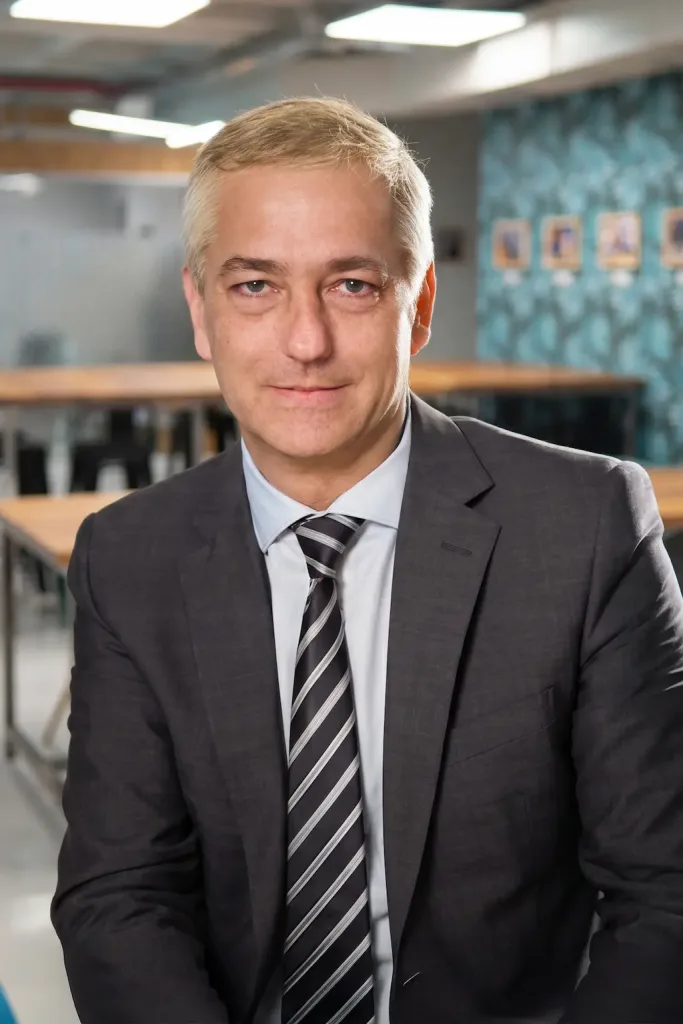
Sergio Horacio
Senior Partner & Head of M&A

Career opportunities
- Forensic Analyst
- Big Data Architect
- Software developer/architect
- Application Developer
- Cybersecurity tools developer
- Game and VR developer
- Chief Technology Officer
- Ethical hacking expert
- Data visualisation expert
- Data Engineer
- Physics simulation programmer
- Artificial intelligence programmer
- Graphics systems and game engine engineer
Career Readiness
The comprehensive training we deliver to our students thoroughly prepares them for the employment market. Through a personalized syllabus, we help them develop professional skills, establish relationships with companies and sail through recruitment processes.
An alternative training
In all our content, we include a percentage of Human Sciences to connect technology with soft skills.
This is what our students say
FAQs for the Software Development Engineering programme
What certification or qualification will I receive on completion of the course?
Once you complete and pass the programme you will receive:
- Título de Computer Entrepreneurship Bachelor por IMMUNE Technology Institute.
- Título de Computer Entrepreneurship Bachelor emitido por el Instituto Nebrija.
Non-regulated and non-official education. The degrees of this training are protected by the Organic Law on Universities.
Can the course be delivered online?
Yes, the program is delivered online with live classes. As such, you will be in direct contact and under the supervision of the teachers, which will enable you to follow the classes and interact in a flexible and natural way.
Is this programme for me?
You want to level up in software engineering
If you are already in or close to the technology world, but know you can go further, this programme helps you strengthen your profile and align it with current software engineering practices and standards.
You are finishing your studies and want to specialise in software
You have the foundations; now it is time to take the leap. Here, you move from theory to practice, building a solid profile in programming, architecture and software development.
You want to change direction towards software engineering
If you feel your career needs a change of direction, this programme gives you a structured, applied foundation to enter the software field with confidence and sound judgement.
You want to grow in your sector with a software engineering profile
You do not need to start from scratch. You can build on what you already know by incorporating software engineering foundations that will make you more competitive and relevant.
You want to learn software engineering through a practical approach
If you are looking for training focused on solving real problems and building solutions, here you develop applied skills from the outset.
You are an entrepreneur or freelancer and want to build software on solid foundations
If you develop your own projects or work independently, this training helps you create more robust, scalable and well-designed products from a software engineering perspective.
Will the tools I need be included in the price of the program?
The tools used throughout the program are licensed for free use, in some cases because we use educational licenses and in others because it is free software.
Is there a careers and employment guidance service?
We have an employability area which, through our Talent Hub program, is responsible for supporting the efforts of our students to enter the employment market. The services we offer include resources to help you search for and prepare for interviews, English tests, resume and/or Linkedin profile guidance, interview and elevator pitch training, and access to our exclusive internship and employment pool.
What are the requirements for my computer?
You will need to have access to a laptop with a camera, microphone and minimum requirements of 8 GB of RAM and an i5 processor.
What is the entry grade required to study Software Engineering?
IMMUNE’s Software Development Engineering programme is not based on a public entry grade requirement, but rather on its own admissions process and assessment of the student’s profile. To find out the specific entry requirements, it is advisable to contact the admissions team.
What is the Capstone Project?
The final project is where everything you have learned throughout the program is applied and consolidated. You will present the project to a panel of professionals from companies in the sector, which represents a unique opportunity for students to demonstrate their knowledge to potential employers and also to network.
How many years does the Software Engineering degree last?
The Software Development Engineering programme lasts 3 years, with the option to complete 1 additional optional year at Dublin Business School (DBS) as part of the programme’s international pathway.
Are there grants or scholarships available?
Yes, there are scholarships or study grants as well as financing options depending on students’ circumstances. Check out our scholarship and financing options.
Book my personalised academic and professional consultation
Flor Biscardi

Agustina Ruíz

Admissions Process
Our students are characterized by their passion for technology. Our admissions process focuses on who you are, how you think, what you have accomplished, and then sharing your goals.
Our aim is to get to know you better, see what makes you unique and ensure that the IMMUNE educational model adapts to your profile.



 English (UK)