

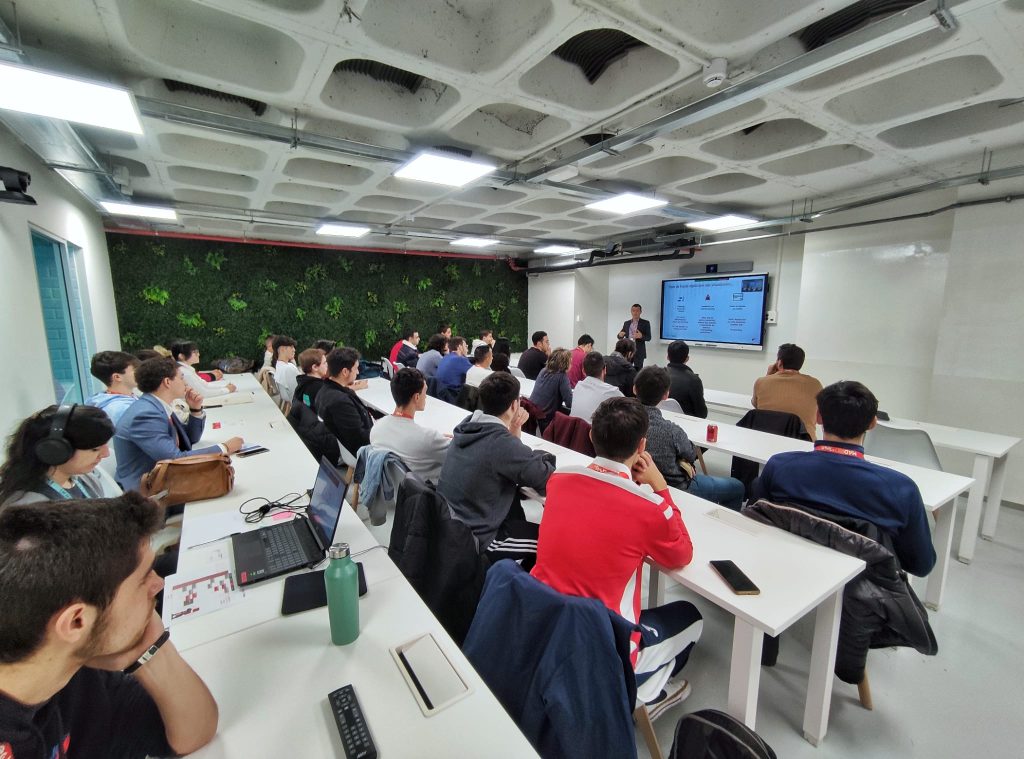
In this article, we want to tell you, from within IMMUNE Technology Institute, how the methodology that shapes our master's degrees and bootcamps works. This isn't an institutional description, but rather sharing with you the essence of what we experience every day in our classrooms and labs in Madrid: the power of learning by doing.
Table of Contents
Introduction: learning by doing, doing by learning
Knowledge only makes sense when put into practice. Neuroscience supports this: a study published in Frontiers in Psychology (2021) demonstrates that students who apply what they have learned through practical experiences retain up to 75%: more knowledge that those who only study theory. In other words, learning is not memorised, it is experienced.
And that is the essence of the approach Learn by Doing. In a world where technologies evolve faster than university curricula, the only way to keep up is by learning through doing. Unlike traditional academic models focused on theory, this method takes learning into the realm of action. Those who program, design, analyse, or build don't just understand the principles; they apply, test, and improve them. It's the difference between knowing a concept and knowing how to solve a real problem, between studying a book and building something that works.
What is the methodology Learn by Doing?
At IMMUNE Technology Institutethe Learn by Doing it is much more than an educational technique: it is a way of understanding technological education. It is based on the active learning, where every concept is experienced, tested, and applied. The student ceases to be a spectator and becomes the protagonist of their own learning process.
This philosophy is materialised in our methodology IDEIA, which unites IResearch, Ddevelopment, Eexperimentation, IInteraction and AApplication. Each learning block combines solid theory with real-world challenges, so that knowledge is transformed into tangible experience, ensuring that each student has an immersive learning experience that is applicable to the workplace.
Business Fundamentals: Why “Learning by Doing” Works”
In the business world, practical experience has always trumped theory. The companies we collaborate with confirm this: teams that learn by doing are more creative, productive, and innovative.
The study Learning Outcomes and Training Satisfaction
A Case Study (Springer, 2024) demonstrated that training programmes with practical components increase perceived competition, knowledge retention and professional satisfaction. In other words, when learning is experienced, it leaves its mark.
This approach produces more resourceful professionals, capable of tackling complex problems and quickly adapting to new tools.
The business world has been applying this logic for years through Corporate hackathons, Innovation laboratories and programmes Upskilling based on challenges. We transfer that same dynamic to our classrooms: learning is building, testing, making mistakes, and improving.
Even from an economic perspective, the value of practical learning has been demonstrated. The Economist Kenneth Arrow proposed this theory to explain how productivity grows as people repeat, experiment, and perfect. Learning by doing not only creates better professionals: create sustainable economic value.
And in the educational field, the model of David Kolb it confirms it: meaningful learning emerges when experience, reflection, conceptualisation and action are combined.
How do we apply The Methodology?
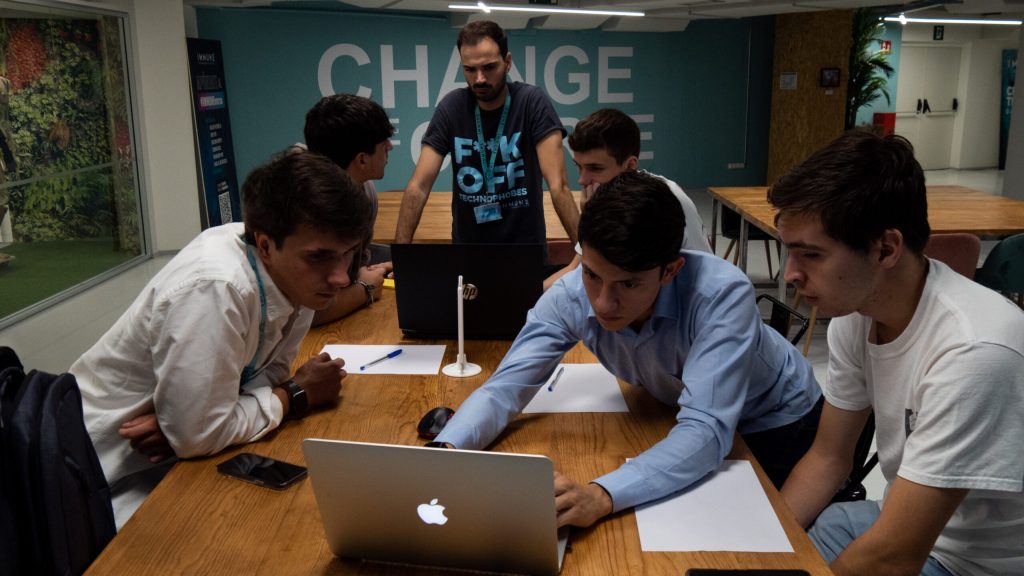
In IMMUNE, Learn by Doing It's not a slogan; it's our way of teaching. Classrooms are transformed into laboratories, students into creators, and projects into real experiences where theory comes to life.
Cybersecurity
Students face attack simulations, design defences, and apply digital forensic analysis techniques. They use tools such as SIEM, IDS, pentesting, and more. Additionally, our Online Master's in Cybersecurity integrate Storytelling methodology, where each challenge is presented as a story with context, conflict, and resolution, making learning more memorable and meaningful.
Cloud Computing/Architecture & DevOps
In the area of Cloud computing and DevOps, students learn to build, automate, and scale real-world technological infrastructures. During the programme, they manage multi-cloud environments in AWS, Azure y Google Cloud, implement containers with Docker, orchestrate processes with Kubernetes and apply Terraform for infrastructure as code.
The projects range from the design of hybrid architectures to the creation of pipelines with Jenkins, including the configuration of load balancers and advanced security systems.
UX/UI Design
In the UX/UI Design Bootcamp, creativity meets technique. Participants develop user-centred digital products applying methodologies Design Thinking and professional tools such Figma, Adobe XD y Miro.
Each stage of the process — from research and ideation to prototyping and usability testing — is experienced as a real challenge, where students must empathise, iterate, and present functional solutions. The result: designers who understand user experience and master end-to-end design processes.
Ciência de Dados e Análise
At the Data Science & Analytics area The student transforms data into applicable knowledge. Learners analyse large volumes of information, clean, model and visualise data using tools such as Python, Power BI, TensorFlow, Pandas, Scikit-learn and Tableau.
But learning goes beyond the technique: through Storytelling methodology, students learn to translate results into stories that communicate value, persuade, and support strategic decisions in real business environments. Each project combines analysis, creativity, and business insight.
Storytelling Methodology
In each area, the projects follow a narrative structure: a context, a conflict, and a resolution. This approach turns each challenge into a profound learning experience, where emotion drives understanding.
Benefits of a practical approach to employability
The Learn by Doing not only does he teach, Get ready to work. Companies are looking for talent that can contribute from day one, and professionals trained under our methodology stand out for their autonomy, adaptability, and critical thinking.
According to the LinkedIn Learning Report 2024the 87% of recruiters prefer candidates with practical experience When faced with those with purely theoretical knowledge. In a constantly changing market, those who learn by doing are one step ahead: they understand the tools, anticipate problems, and transform challenges into opportunities.
Our graduates not only master the technique, but also develop soft skills such as communication, time management, and teamwork, essential competencies for leading technological and multidisciplinary projects.
Conclusion: the education of the future is built by doing
At IMMUNE Technology Institute, we believe that the education of the future is not about memorising: It is built with the hands, the mind, and experience. Learn by Doing It's not a trend, it's a philosophy that reflects how we understand learning and innovation.
Every project is an opportunity to learn, every mistake a lesson, and every achievement a display of evolution. Because knowledge can be forgotten, but the experience remains and transforms.

 English (UK)