

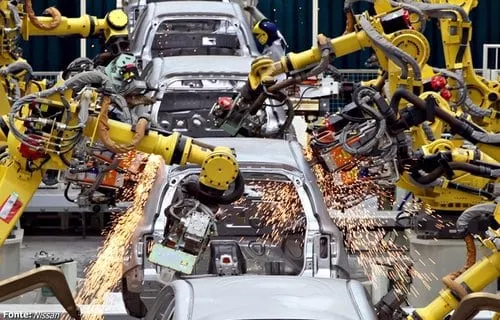
Machines are increasingly taking over jobs in both large and small cities, but it is the latter that have the greatest area of impact, according to a recent study by the MIT Media Lab. Diversification can create new jobs in smaller cities.
The citizens of these types of sparsely populated cities are leaving their homes in search of a better quality of life, a wider range of services, and employment. Automation is more intense in small centres due to the nature of jobs such as «service tasks, factories, and agriculture, which are susceptible to automation,» according to Esteban Moro, a researcher at the Media Lab and a professor at the Carlos III University of Madrid.
Instead, large cities bring together the most qualified workers to use technology. «Mathematicians, chemists, data scientists, and software developers are the professions that will suffer least from automation,» explains Moro.

Despite the massive digital offer of big cities, infrastructure and social services are limited, as are space and housing. By 2050, almost 70% of the world's population (around 6.3 billion) will live in cities, i.e. a new rural exodus is looming. This will be accompanied by an increase in economic and social contrasts and a worsening of service and waste management.
Faced with these predictions, experts are promoting the use of technology and data to try to reduce mobility and housing problems, as by 2025 the world will have 37 megacities (with more than 10 million inhabitants). «Cities need to be better organised, and that is now easier thanks to all the existing information,» adds IESE Business School researcher Carlos Carrasco.
»For public transport planning, we can analyse how the population moves, define where to put more services and at what times they should be more frequent," Carrasco points out. Furthermore, pollution can be reduced thanks to autonomous vehicles, which according to Brack will reduce the need for private car ownership and parking problems, and through the use of renewable energies, the cost of which continues to fall.
In terms of urban planning, the physical growth of a city is influenced by its geography. «Theoretically, there is no limit to the size of cities. However, in practice, the growth of most urban centres is tied to their inability to manage their size,», Explain McKinsey & Co partners Richard Dobbs and Jaana Remes. For example, Hong Kong (China), one of the most densely populated areas in the world, is 85% surrounded by water, and its possibilities for expansion involve creating artificial islands or extending the coastline, as suggested by urban planners from the MAP Office in Hong Kong and the Network Architecture Lab of Columbia University in New York (USA). A solution for a specific case that is far from being generalisable.

Small but specialised cities
For their part, smaller cities face the challenge of transforming themselves to avoid losing their population, and they can attack on several fronts. «There are a number of worker competencies that are difficult to automate: social skills, such as working in a group and helping people. The task of small cities is to ensure people acquire these so that in the future they are not quickly replaced by an artificial intelligence system or a robot,» opines Moro.
On the other hand, there are also «small towns that have specialised in very high-value sectors, such as the mining or energy industry». So another solution would be the creation of investment hubs, where small towns come together and create a larger nucleus where specific business models are developed. This is the case of Research Triangle Park, in North Carolina (USA), where «three cities have specialised in biomedicine and have made agreements with universities and companies to create a sort of industrial hub,» explains Moro.
But even though a cluster of companies, such as the specialising in aeronautics at El Prat (Spain), it can help small cities, it can also make them dependent on the sector to which they belong. «If it sinks, the impact is much greater than if you have a diversified industry, which is what happens in large cities,» clarifies Carrasco. For this reason, she advises following new trends and pivoting specialisation according to how the global economy is moving. Furthermore, she calls for collaboration instead of competition: «Small cities have to look for synergies with big cities. This way, they will have a better chance of surviving.».
The optimal solution to this system of equations about the challenges of small and large cities, if there is one, is far from unique. Perhaps the best idea to solve it is to train an artificial intelligence and ask a robot.
Source: MIT